Event lighting changes a room more than anything else you can rent, and two choices drive most of the effect. First, color temperature in Kelvin: ENERGY STAR puts 2200K to 3000K in the warm range and 5000K to 6500K at daylight. Second, fixture type, since an uplight, a wash and a pin spot do different jobs. LEDs do nearly all of it now, using at least 75% less energy than incandescent and lasting up to 25 times longer, says the Department of Energy. For real candles, check local fire rules first.
A plain conference room and a beautiful one are often the same room. The difference is event lighting.
That sounds like marketing, but it is physics. You are changing what walls reflect, where eyes go, and how skin looks on camera. Three things decide if it works:
- Whether the white light is warm or cool enough for the room and the hour.
- Whether the fixtures match the job rather than the budget line.
- Whether someone thought about the ceiling, the power and the sight lines first.
Our lighting crews start from the room, not a kit list.
Start with color temperature, not color
Most people jump to “can we have purple”. The better question is how warm or cool the white light should be, since that sets the mood before any color arrives.
ENERGY STAR publishes the scale. Lower Kelvin means warmer and yellower, higher Kelvin means cooler and bluer.
| Kelvin | Name | ENERGY STAR says |
| 2200K to 3000K | Soft white, warm white | Ideal for most indoor applications |
| 3500K to 4100K | Neutral white, cool white | Good for kitchens and work spaces |
| 5000K to 6500K | Daylight | Good for reading, like blue sky at noon |
What that means for an event:
- Dinners and receptions sit in the warm range. It flatters skin and makes a room feel smaller and softer.
- Trade show booths and demo areas sit cooler, because people need to see detail.
- Mixing both in one sightline looks like a mistake rather than a choice.
One more number: lumens measure light output, watts measure energy used. A supplier quoting watts is describing their power bill, not your room.
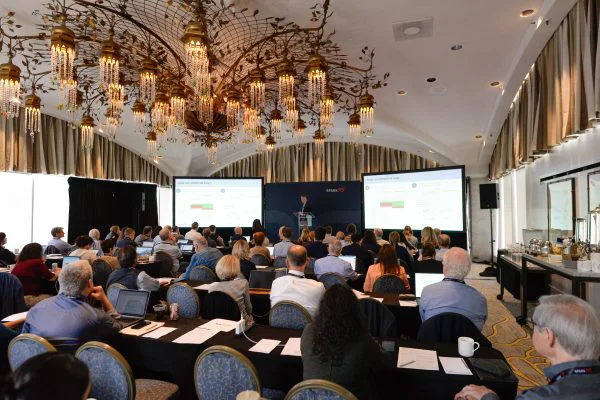
What the different fixtures actually do
This is where most event lighting quotes get vague. The names sound interchangeable and are not.
| Fixture | What it does | Best used for |
| Uplight | Sits on the floor, throws light up a wall or column | Changing the color and feel of a whole room cheaply |
| Wash | Spreads even light across a wide area | Stages, backdrops, general coverage |
| Pin spot | Tight, narrow beam | Centerpieces, cakes, a single object |
| Gobo | Projects a pattern or logo through a cut stencil | Monograms, textures, branding on walls or floors |
| String or festoon | Warm points of light overhead | Outdoor areas, tents, a relaxed feel |
Buy uplighting first. It does the most visible work per dollar, changing the surface people look at most: the walls.
Logos and patterns are where lighting meets design, so our event graphics and lighting plans get built together.
Why LEDs took over event lighting
This matters in rooms with limited power.
The Department of Energy says LEDs “use at least 75% less energy, and last up to 25 times longer, than incandescent lighting”, and “emit very little heat”, while incandescent bulbs “release 90% of their energy as heat”.
| LED | Incandescent | |
| Energy use | At least 75% less | Baseline |
| Lifespan | Up to 25 times longer | Baseline |
| Heat | Very little | 90% of energy released as heat |
| Beam | Directional by design | Needs reflectors and diffusers |
Three practical results:
- You can run far more fixtures on the same circuits, which matters in older venues.
- Color changes happen in the fixture, so no gel swaps mid-event.
- Nobody gets burned packing down, and the room stays cooler.

The control layer nobody mentions
This separates a lighting design that works from one that nearly works.
Fixtures from different makers talk to a console through one shared standard, ANSI E1.11 – 2024, better known as DMX512-A, published by ESTA for controlling lighting equipment.
The point is interoperability: mixed fixtures run from one console because they speak one protocol.
- Ask whether every fixture is on one control system, or whether some are on remotes.
- Remotes are where cues go wrong, because nobody is holding them at the right moment.
- Agree cue points in advance: doors, dinner, speeches, dancing. Every lighting design needs them.
Cue timing is a run of show problem, so lighting and event planning belong in one conversation.
Candles and open flame have real rules
Real flame is lovely and heavily regulated. San Francisco shows how specific it gets.
San Francisco’s Fire Department allows candles and open-flame decorative lighting in assembly occupancies with Bureau of Fire Prevention approval. The requirements are exact:
| Requirement | Detail |
| Enclosure | “The flame shall be enclosed in a non-combustible chimney” |
| Side openings | Must not exceed 3/8 inch in diameter |
| Safety test | Chimney design must stop tissue paper igniting within 10 seconds on top |
| Candelabras | Securely fastened, away from occupants, drapes, curtains and combustibles |
| Larger devices | Over 8 ounces must be self-extinguishing and leak-resistant |
| Permit | P-238 Temporary Use, or P-138 Use of Open Flame |
| Fuel | Class I and II liquids and LPG are prohibited as a fuel source |
Check your own jurisdiction, since details differ. The pattern does not: real flame means a permit, an enclosure and an inspection. Build it into the lighting design early.
- Battery candles pass every rule and read convincingly at a distance.
- Decide this early, since permits and inspections need lead time.
Light the load-in, not just the party
Almost nobody plans this. Your crew works in a half-dark room before the pretty event lighting exists, and there are legal minimums.
OSHA requires work areas lit to the Table D-3 minimums while work is in progress, in foot-candles:
| Foot-candles | Area |
| 3 | General construction areas, access ways, loading platforms, active storage |
| 5 | General area lighting, and indoor warehouses, corridors, hallways, exitways |
| 10 | Plant and shops, equipment rooms, rigging lofts |
| 30 | First aid stations, infirmaries, offices |
Ask whether house lights stay up during load-in and strike. If not, work lights join the plan.
Same muscle behind good audio visual delivery, since both crews share the room, power and clock.
Key Takeaways
- Color temperature decides the mood before color does. ENERGY STAR puts 2200K to 3000K in the warm range and 5000K to 6500K at daylight.
- Lumens measure light output and watts measure energy used, so judge brightness by lumens.
- Fixtures are not interchangeable. Uplighting changes a room, a pin spot picks out one object.
- LEDs use at least 75% less energy and last up to 25 times longer than incandescent, so you can run more of them on the same power.
- DMX512-A, published as ANSI E1.11, is why mixed fixtures run from one console. Ask what is on the system and what is on a remote.
- Real candles mean a permit, a non-combustible chimney and an inspection. Decide early or use battery candles.
Frequently Asked Questions
What is event lighting, in plain terms?
Any lighting brought in to change how a space looks and feels, not just to let people see. In practice: uplights on walls, washes on a stage, pin spots on tables, projected patterns, and a console running cues.
What color temperature should I use for a wedding or dinner?
Warm, the 2200K to 3000K range ENERGY STAR calls soft or warm white. It flatters skin and photographs well. Save 5000K and above for areas where guests need to read.
How much does event lighting change a room?
More than anything you can rent, because it changes what every wall reflects. Uplighting a plain ballroom in one color alters it without moving furniture, which is why event lighting starts there.
Is uplighting worth it?
Yes, for most rooms. It is the most visible change per dollar, since walls are the biggest surface guests look at. A plain venue with warm uplighting reads as a designed space.
It is also the easiest win on a corporate event budget.
Can I use real candles at my event?
Often, but not freely. San Francisco’s Fire Department requires Bureau of Fire Prevention approval, a non-combustible chimney with side openings no larger than 3/8 inch, and a P-238 or P-138 permit. Rules differ by city, and battery candles avoid all of it.
Do I need lighting for a virtual or hybrid audience?
Yes, and differently. A camera needs even light on faces, which is not what looks good to the eye. Getting both is core to our hybrid event plans.
Planning event lighting for a Bay Area event? Tell us the venue, the headcount and the look you want, and we will tell you what the room actually needs. Contact us or call 415-545-8635.