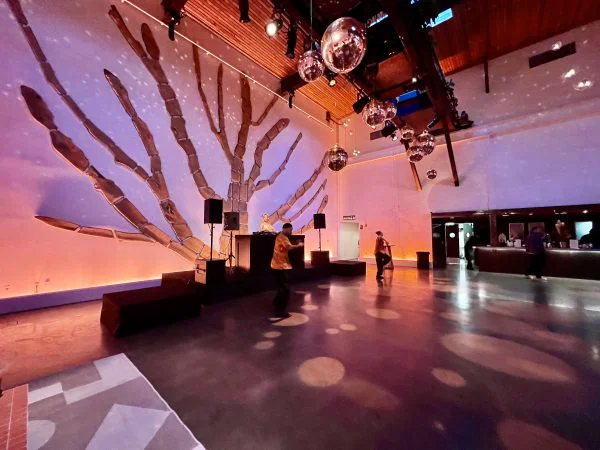
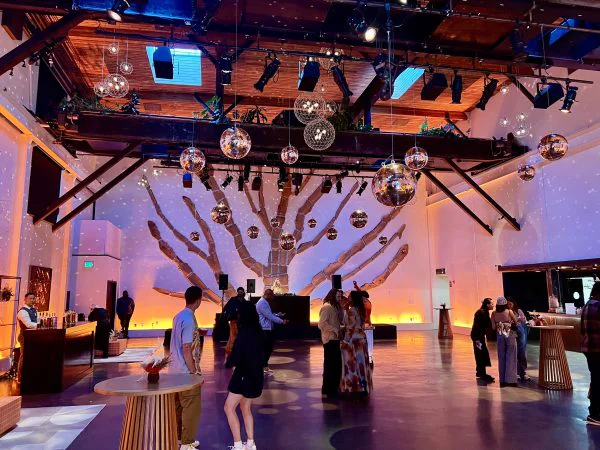
The importance of event lighting is easiest to see in a before-and-after. At AVEVA World After Dark we used video mapping, bistro lights, LED chandeliers and uplighting to turn a daytime pavilion into a nighttime space. Lighting also does the most per dollar, since LEDs use at least 75% less energy than incandescent and emit almost no heat, per the Department of Energy. If you are planning event lighting in San Francisco, two local things matter: real flame needs an SFFD permit, and at Moscone your lighting crew works alongside IATSE Local 16 with a facility House Head attached.
Ask which rental changes a room most and the answer is always the same. Not the furniture, not the linens. The lights.
That is hard to argue in the abstract, so here is a room we actually did, then the local rules that decide what is possible.
- The same pavilion, read as two different venues.
- Energy and heat numbers that explain why LED changed what is affordable.
- The San Francisco permits and crew rules nobody mentions until load-in.
Our lighting crews start from the room rather than a kit list.
What changed at AVEVA World After Dark
One venue, one day, two different spaces. Here is what each element did.
| Element | What it did |
| Video mapping on the exterior | Projected logos and custom content onto blank building surfaces |
| Bistro lights | Set the mood indoors, warm and low |
| LED chandeliers | Added a sense of occasion overhead |
| Uplighting across multiple stages | Turned a daytime venue into a nighttime escape |
| Custom lighting through the pavilion | Tied separate areas into one space |
Three jobs were happening at once:
- Mood, from the bistro lights and chandeliers.
- Illumination, from stage lighting so presentations actually read.
- Visual impact, from uplighting that changed the room’s character entirely.
Most rooms only get the second. That is why they look like a conference, not an event.
Video mapping is the underestimated one. A blank wall becomes a branded surface with no print and no signage install, which is why it pairs with event graphics planning.
Why lighting does the most per dollar
The practical core is simple: you are changing the biggest surfaces in the room, the walls and ceiling.
LED changed the economics. The Department of Energy says LEDs “use at least 75% less energy, and last up to 25 times longer, than incandescent lighting”, and “emit very little heat”, while incandescent bulbs “release 90% of their energy as heat”.
| LED | Incandescent | |
| Energy use | At least 75% less | Baseline |
| Lifespan | Up to 25 times longer | Baseline |
| Heat | Very little | 90% of energy released as heat |
What follows from that:
- You can run many more fixtures on the same circuits, which matters in older venues.
- Color changes happen inside the fixture, so no gel swaps mid-event.
- The room stays cooler, and nobody gets burned at strike.
Warmth is the other lever. ENERGY STAR puts 2200K to 3000K in the warm range and 5000K to 6500K at daylight, so a dinner and a demo area want different white light.
Event lighting in San Francisco: who is allowed to hang it
Here is the part that surprises out-of-town planners.
At Moscone Center, any event involving “staging, lighting, large-scale video and sound reinforcement, or a major theatrical presentation” must include the facility’s House Head on the team. Moscone describes that role as:
- Appointed by the facility to assist the IATSE Local 16 crews.
- Acting as union steward on site.
- Holding the expertise on jurisdictional requirements and building systems.
- Your lighting designer still designs. The hanging and power work runs through the house crew.
- Budget the labor accordingly, because it is not optional and it is not cheap.
- Meeting room floorplans are due 45 days before move-in.
- Truss plans and a D-size floorplan go to the Event Manager on the first day of keynote move-in.
Those lead times are the real constraint on an ambitious design. A design finalized three weeks out has nowhere to go, so lighting belongs in the first event planning conversation.
The permits San Francisco actually requires
Real flame is a permit conversation, not a styling one.
| What you want | What it needs |
| Candles or fireplaces | SFFD operational permit |
| Pyrotechnics | SFFD operational permit |
| Tents over 700 sq ft | SFFD operational permit |
| Portable cylinders, propane or flammable gases | SFFD operational permit |
| Outdoor amplified sound, including terraces | SF Entertainment Commission permit |
| Food or drink not from the in-house caterer | SF Department of Public Health, minimum two weeks before day one |
The candle rules are unusually exact. San Francisco’s Fire Department requires the flame enclosed in a non-combustible chimney with side openings no larger than 3/8 inch, a design that will not ignite tissue paper placed on top within 10 seconds, and a P-238 or P-138 permit.
- Battery candles meet every rule and read convincingly beyond a few feet.
- Decide early, since permits and inspections need lead time.
- On the city side, a One Time Entertainment Event Permit runs $586, and the Entertainment Commission notes its fees rise 2 to 3% a year.
Light the work, not just the party
Almost nobody budgets for this. Your crew builds the room in the dark before the pretty lighting exists, and OSHA sets minimums, in foot-candles, while work is in progress.
| Foot-candles | Area |
| 3 | General areas, access ways, loading platforms, active storage |
| 5 | General area lighting, and indoor corridors, hallways, exitways |
| 10 | Plant and shops, equipment rooms, rigging lofts |
| 30 | First aid stations, infirmaries, offices |
Ask whether house lights stay up during load-in and strike. If not, work lights are a line item.
Same muscle behind good audio visual delivery, since both crews share the room, power and clock.
Key Takeaways
- The importance of event lighting is that it changes the largest surfaces in the room, the walls and ceiling, which is why it beats every other rental per dollar.
- At AVEVA World After Dark, video mapping, bistro lights, LED chandeliers and uplighting turned one daytime pavilion into a nighttime space.
- Separate the three jobs: mood, illumination and visual impact. Most rooms only get illumination.
- LEDs use at least 75% less energy and last up to 25 times longer than incandescent, so more fixtures fit on the same power.
- In San Francisco, Moscone requires a facility House Head alongside IATSE Local 16 for any event with staging or lighting, and meeting room floorplans 45 days ahead.
- Real flame needs an SFFD permit, a non-combustible chimney and an inspection. Battery candles avoid all of it.
Frequently Asked Questions
What is the importance of event lighting?
It changes the biggest surfaces guests look at, the walls and ceiling, so it alters a room more than furniture or linens can. It also does three jobs at once: mood, legibility for presentations, and visual impact.
How much difference does event lighting really make?
Enough that one venue reads as two different places. At AVEVA World After Dark the same pavilion went from daytime to nighttime using uplighting, bistro lights, LED chandeliers and projection, with no change to the room itself.
What do I need to know about event lighting in San Francisco?
Two things. Real flame needs a San Francisco Fire Department operational permit, with a non-combustible chimney and an inspection. And at Moscone any event with staging or lighting must include the facility’s House Head working with IATSE Local 16, so that labor is in your budget from the start.
How far in advance should I plan event lighting?
Earlier than most people do. Moscone wants meeting room floorplans 45 days before move-in and truss plans on the first day of keynote move-in. Open flame permits need their own lead time on top.
Is video mapping worth it for a corporate event?
Often, yes. It turns a blank exterior or wall into a branded surface with no printing or signage install, and the content can change through the event. A good option when a venue hands you large plain surfaces, which many corporate event spaces do.
Do I need lighting designed differently for a camera?
Yes. A camera needs even light on faces, which is not the same as a room that looks good to the eye. Lighting a space and lighting a broadcast are two briefs, and getting both is core to our hybrid event work.
Want event lighting that transforms the room? Tell us the venue, the headcount and the look you are after, and we will tell you what it takes and what the venue will allow. Contact us or call 415-545-8635.