Walk into a ballroom five minutes before doors and you can tell whether the lighting was planned or improvised. Effective event lighting is the difference between a room that photographs beautifully and one that looks flat and half-asleep, and it costs less to get right than most planners expect.
Effective event lighting is lighting designed in layers (an ambient wash, accent fixtures for focal points, and task light for stages and walkways) matched to the venue’s power, ceiling height and camera needs. Plan it during a site visit, budget roughly $400 to $2,000 for a typical wedding or corporate event, and test the rig a day before doors.
These event lighting tips cover what decides the outcome: the walk-through, the layers, color, cost, and the mistakes nobody spots until the photos land. Use the table below as the short version of effective event lighting planning.
| Decision | Get it right by |
| Venue fit | Walking the room and building a lighting plot |
| Design | Layering ambient, accent and task light |
| Color | One wall color, one optional ceiling color |
| Camera | Front light plus backlight on every face |
| Budget | Asking for an all-in total, not a per-fixture rate |
What Makes Effective Event Lighting Work?
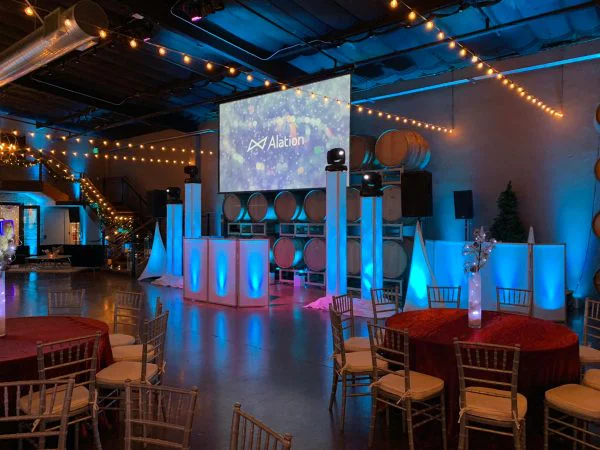
Effective event lighting does three jobs at once: it lets people see, it shapes how the room feels, and it makes the important things impossible to miss. If a fixture isn’t doing one of those, it’s decoration.
Most rooms fail on the second job. House lights are built for setup and cleaning, so a ballroom lit only by its own downlights reads as beige. Good event lighting design replaces that flat wash with intent. That’s the premise behind VEP’s lighting and decor services.
Start With the Venue, Not the Fixtures
The most common mistake is picking effects before understanding the room. Ceiling height, wall color and available power decide what effective event lighting can do there.
Build a Lighting Plot During the Site Visit
A lighting plot is a scaled floor plan showing where every fixture sits, where it aims and what it plugs into. Work through this event lighting checklist on site:
- Ceiling height, rigging points and truss access
- Power: outlet locations, circuit capacity, distance to the panel
- Ambient light: windows, skylights, exit signs, lobby spill
- Wall color and texture, since dark walls swallow color
- Obstructions: columns, drapery and soffits that block beam angles
Confirm electrical and rigging policies in writing, not by handshake. Historic venues, tents and rooftops restrict what you can hang or plug in. Outdoor event lighting adds weather: weatherproof fixtures, lights secured against wind, and battery or generator power with a backup. Folding all of this into the run of the show early is what event planning support is for.
Layer Your Lighting: Ambient, Accent and Task
Effective event lighting works in three layers. Skip one and guests feel it without being able to name what’s wrong.
| Layer | What it does | Typical fixtures | Skip it and… |
| Ambient | Sets the room’s overall level and mood | Uplights, wash lights, chandeliers | The room reads flat and beige |
| Accent | Picks out objects and architecture | Pin spots, gobos, tree lights | Centerpieces and branding disappear |
| Task | Makes people and paths visible | Stage lighting, followspot, pathway light | Your keynote speaks from shadow |
Fixture Quick Reference
| Fixture | What it does | Best for |
| LED uplights | Wash walls and columns with color from floor level | Ballrooms, tents, blank walls |
| Gobo projector | Projects a logo, monogram or pattern onto a surface | Branding, sponsor walls, dance floors |
| Pin spot lighting | Narrow beam aimed straight down | Centerpieces, cake, product displays |
| Moving head | Programmable beams that shift mid-event | Reveals, awards, dance floor lighting |
Uplighting means placing LED uplights on the floor and aiming them upward to wash walls with color. It’s the highest-impact, lowest-cost move in effective event lighting. Plan roughly one uplight per 6 to 12 feet of wall, clustered tighter for a smoother wall wash.
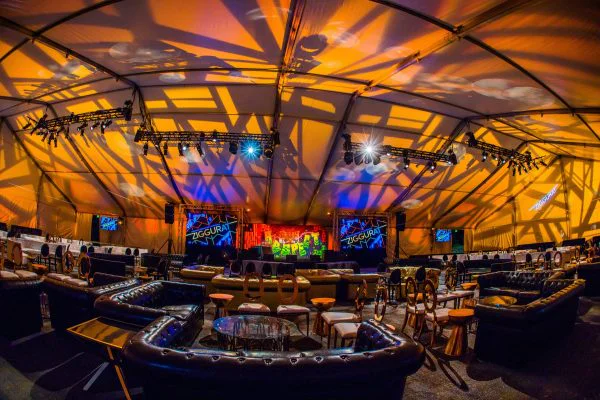
A gobo is a metal or glass template placed in front of a light to project a pattern or logo. In corporate event lighting, one gobo projection does more brand work than a banner, which is why it appears in nearly every corporate event we produce.
Get Color and Brightness Right
In event lighting design, color drives mood more than fixture count does.
| Color | Mood it creates | Best for |
| Amber / blush | Warm, intimate, flattering on skin | Weddings, awards dinners |
| Cool white | Clean, alert, professional | Conferences, product launches |
| Deep blue / magenta | High energy, nightclub feel | Dance floor lighting, after-parties |
Brightness matters just as much: harsh rooms cause eye strain, dim rooms make food look unappetizing. Keep guest areas soft, save the punch for the stage, and build a cue list so effective event lighting shifts with the run of show: bright at dinner, dimmed for awards, saturated for the party.
Light for Cameras, Not Just for the Room
If your event is photographed or streamed, the camera is the strictest audience effective event lighting has to satisfy. A stage that looks fine to the eye often records as a silhouette.
- Front light on every face, ideally from two angles at roughly 45 degrees
- Backlight to separate the presenter from the background
- Dim the fixtures nearest any screen so faces expose without washing out content
This is where lighting and audio visual production stop being separate line items.
It matters most for live streamed and hybrid events, where the remote audience only ever sees the camera feed and has no room to compensate for a badly lit stage.
What Effective Event Lighting Costs
Ranges are wide because scope varies, but these benchmarks help you sanity-check a quote.
| Event type | Typical budget | Usually covers |
| Wedding lighting package | $400 – $1,500 | Uplighting, pin spots, dance floor wash |
| Corporate event lighting | $500 – $2,000 | Stage wash, uplights, gobo projection |
| Full stage production | $3,000 – $5,000+ | Truss, moving heads, programmed cues, tech |
| Individual LED uplights | $17 – $65 each | Fixture only, wired or wireless |
Always ask for a total, not a per-fixture rate. Labor, power distribution and strike are where quotes diverge, and a cheap per-light price with a long labor minimum isn’t cheap. .VEP’s portfolio shows what each budget tier looks like in a real room.
Event Lighting Mistakes to Avoid
| Mistake | Fix |
| Lighting the ballroom, forgetting the entrance | Light the arrival path; the experience starts at the car |
| Four competing colors on one wall | One wall color, one optional ceiling color |
| Fixtures aimed at seated eye level | Angle beams up, away from sightlines |
| Booking the test for show day | Test the real rig in the real room 48 hours out |
Frequently Asked Questions
How much does event lighting cost?
Most effective event lighting packages cost between $400 and $2,000, with individual LED uplights renting for roughly $17 to $65 each. Weddings sit at the lower end, corporate event lighting in the middle, and truss-and-moving-head productions can exceed $5,000.
How many uplights do I need?
Plan about one uplight per 6 to 12 feet of wall you want covered. A 100-guest banquet room usually needs 12 to 20 fixtures, and tighter spacing gives a smoother wash.
What’s the difference between uplighting and wash lighting?
Uplighting sits on the floor and throws light upward along a vertical surface. Wash lighting spreads even color across a broad area from any position, including overhead.
Is DIY or professional lighting better?
DIY rentals make sense for one static color in a simple indoor room. Hire a professional for cue changes, stage or camera lighting, or a tricky venue. The dividing line is control: if looks change mid-event, you want a technician.
What lighting do I need for a live-streamed event?
You need front light on every speaker’s face, backlight for separation, and dimmable fixtures near any screen. Cameras have far less dynamic range than your eyes, so effective event lighting for a stream is brighter and flatter than it feels in the room.
Key Takeaways
- Effective event lighting works in three layers (ambient, accent and task), and dropping one is immediately noticeable.
- Document the venue first: ceiling height, power and rigging points belong in a lighting plot before you choose fixtures.
- Floor-mounted color delivers the most visual change per dollar, but stick to one wall color plus one optional ceiling color.
- Light faces for the camera with front and back light whenever an event is photographed or streamed.
- Budget $400 to $2,000 for most effective event lighting packages, and test the rig in the real room 48 hours before doors.
Ready to Light Your Next Event?
Lighting rewards planning more than budget. A room mapped on site, lit in deliberate layers and tested before doors beats a bigger package thrown at an unfamiliar space.
Rather hand the plot, the rig and the cue list to a team that does this weekly? Talk to VEP about your event. We’ll walk your venue, build the event lighting design around your run of show, and make sure it reads right on camera.